How to Import Goods into The Bahamas: A Complete Beginner's Guide

New to importing in The Bahamas? Learn the step-by-step process — documents, duties, and how a licensed customs broker handles everything for you.
Whether you're ordering appliances from the US, bringing in inventory for your business, or shipping personal belongings back home, importing goods into The Bahamas involves more steps than most people expect. The good news is that most of those steps are not yours to manage — that's what a licensed customs broker is for.
This guide explains who does what, what you need to provide, and what happens from the moment your shipment leaves the seller to the moment you can collect it.
Who Does What: The Three Key Players in Every Import
Before diving into paperwork, it helps to understand who the different parties are and what role each one plays.
The Consignee
This is you — the person or business receiving the goods in The Bahamas. Your job is to provide the right documents, pay your freight forwarder and your customs broker, and arrange to collect your goods once they are cleared. The legal responsibility for ensuring goods are properly declared sits with you, which is why working with a licensed broker matters.
The Freight Forwarder
A freight forwarder arranges the international transportation of your goods — booking cargo space on airlines or container ships, managing logistics from the seller's country to The Bahamas, and issuing the Bill of Lading or Airway Bill. A freight forwarder does not clear your goods through Bahamian Customs. That is a separate role entirely.
The Licensed Customs Broker
A licensed customs broker is a professional authorised by the Bahamas Customs & Excise Department to handle the customs clearance process on your behalf. Your broker calculates the duties and taxes owed, prepares your entry in the government's Click2Clear system, attaches your supporting documents, pays the duties, and liaises with Customs officers — all without you having to set foot in a government office.
Before You Start: Register for Click2Clear
Click2Clear is the Bahamas government's official electronic customs system. Every cargo import into The Bahamas — whether by air or sea — is processed through it. Before your first shipment arrives, you will need to register for an account at the link below.
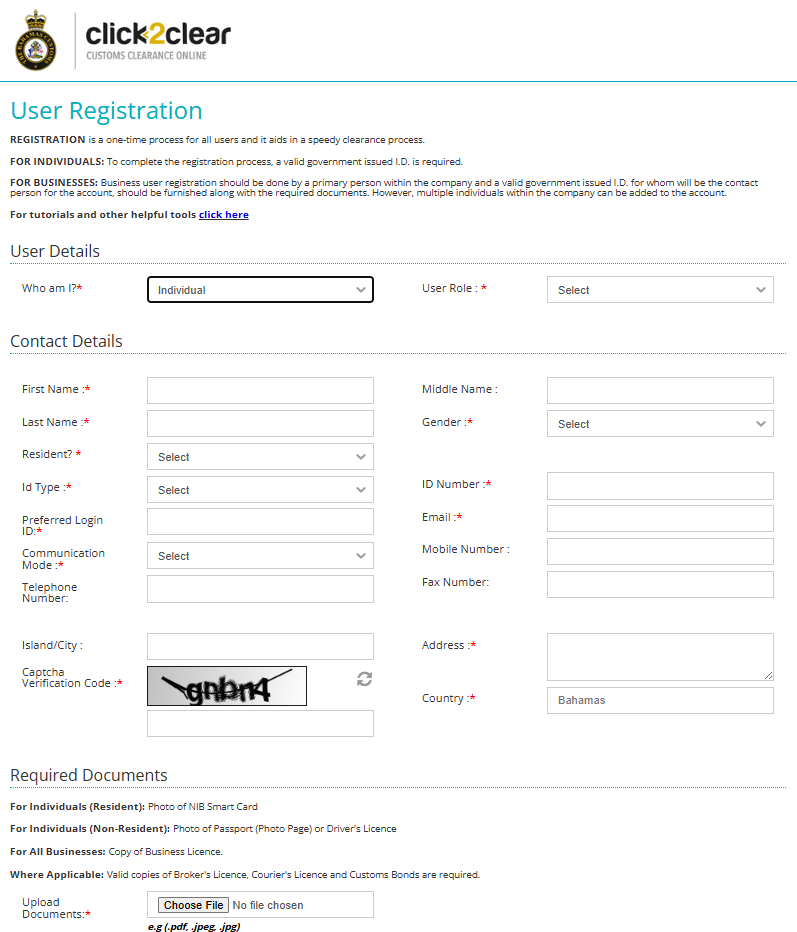
You will need your National Insurance Smart Card and valid identification to complete registration. Once you have an account, your customs broker will be able to act on your behalf within the system when processing your entries. You only need to register once.
Step 1: Give Your Broker the Right Documents
The single most common cause of delays at Customs is missing or incomplete documentation. Your main job as the consignee is to get the following documents from your supplier and freight forwarder and pass them to your customs broker before the shipment arrives.
Commercial Invoice
Provided by your supplier. It must show the full description, quantity, and value of every item in the shipment — this is what Customs uses to calculate what you owe. The invoice must be in a non-alterable format (PDF or JPG) and cannot be tampered with after the fact. If it is missing or the values look incorrect, Customs can hold your goods.
Bill of Lading (sea freight) or Airway Bill (air freight)
Issued by your shipping line or airline. This confirms your goods are on board and provides the key shipment details: origin, destination, vessel or flight number, and freight charges. For sea freight, you will typically need the original Bill of Lading to take possession of your goods.
Freight Invoice
A separate document from the commercial invoice, issued by your freight forwarder. It shows what you paid for the international shipping. Your broker needs this to establish the full CIF value — the basis for calculating your duties.
Permits and Certificates (where applicable)
Certain categories of goods — food, agricultural products, plants, animals, pharmaceuticals — require permits from the relevant Bahamian government agencies before they can be cleared. Your broker will tell you if your goods require one, but the earlier you find out, the better. Always check before the shipment leaves the exporting country.
Once your broker has these documents, they handle everything from this point forward.
Step 2: Your Broker Calculates and Pays Your Duties
Your customs broker will calculate exactly what you owe, submit your entry through Click2Clear, and pay the duties and taxes on your behalf. Here is how the calculation works, so you know what to expect.
The Duty Formula
Duties are calculated based on the CIF value of your goods — the purchase price, plus international shipping costs, plus insurance. You pay duty on the full landed value, not just the item's price tag.
The charges are applied in this order:
- Customs Duty — CIF Value × the applicable duty rate (rates range from 0% to over 100% depending on the goods category)
- Processing Fee — 1% of the CIF value, minimum $10, maximum $1,000
- Environmental Levy — a fixed or percentage-based fee depending on the specific goods
- VAT (10%) — applied to the total landed cost — meaning all of the above combined
A Simple Example
A television from the US costs $1,000, with $200 in shipping. CIF value: $1,200.
- Customs Duty (35%): $350.00
- Processing Fee (1%): $12.00
- Environmental Levy: $10.00
- VAT (10% of landed cost): $157.00
- Total duties & taxes: ~$529.00
The true cost of bringing that TV into The Bahamas is closer to $1,729. Knowing this before you commit to an import is exactly the kind of calculation your broker can give you upfront.
Duty-Free Items
Some goods attract 0% customs duty — baby clothing, books, computers, and certain medicines are common examples. However, duty-free does not mean tax-free. These items are still subject to the processing fee, environmental levy, and VAT.
Once your broker has confirmed the amount owing, they will collect payment from you and settle it with Customs directly.
Step 3: Pay Your Bills, Collect Your Receipts, Collect Your Goods
Once you have paid your freight forwarder and your customs broker, your broker will provide you with the relevant receipts and documentation confirming your goods have been cleared. With those in hand, you can either collect your goods directly from the port or air cargo facility, or arrange for a delivery service to collect them on your behalf.
That's it — from your side, the process is straightforward. The complexity sits with the professionals you've hired.

Quick Reference: What You Need to Provide
- Register for Click2Clear before your first shipment
- Commercial invoice (PDF or JPG, from your supplier)
- Bill of Lading (sea) or Airway Bill (air), from your freight forwarder
- Freight invoice showing shipping costs
- Any applicable permits (food, agriculture, animals, pharmaceuticals, etc.)
- Payment to your freight forwarder and customs broker
Frequently Asked Questions
Do I need a customs broker to import goods into The Bahamas?
Yes. A licensed customs broker is required to submit commercial import entries through Click2Clear on your behalf. They are not optional — they are the professional authorised to handle your clearance. Working with an experienced broker also protects you from errors, delays, and potential penalties.
What is the difference between a freight forwarder and a customs broker?
A freight forwarder arranges the international transportation of your goods to The Bahamas. A customs broker handles the legal clearance process once those goods arrive. They are complementary but separate services — you will need both, and they do different things.
How long does customs clearance take in The Bahamas?
For a straightforward shipment with complete documentation, clearance can often be completed within a few hours of the entry being filed. Delays typically come from missing documents or a shipment being flagged for physical inspection by Customs.
What happens if my invoice is missing?
Customs requires a proper invoice for every import. Contact your supplier immediately to have a copy sent electronically. Your goods cannot be cleared without one.